MongoDB Schema Design: Embedded vs Referenced with Examples
Learn the difference between embedded and referenced data in MongoDB using simple examples from a streaming platform database.


users document with referenced data between users and payments.When you design a MongoDB database, one of the first choices is this:
Should this data stay inside the same document, or should it live in another collection?
That is the difference between embedding and referencing.
Embedding means the data is stored inside the document.
Referencing means the data is stored in another collection and connected with an _id.
That’s the main difference.
Let’s use a simple database called streaming_platform_db.
It has collections like users, movies, series, episodes, payments, ratings, watch_history, and activity_logs.
The database works like a basic streaming platform.
A user can have a subscription, profiles, and devices. The same user can also make payments, watch content, rate movies, and create activity logs.
That makes this database a good example because it uses both embedded data and referenced data.
Visual Schema Design
In Visualeaf, I generated a schema diagram for the streaming_platform_db database.
This makes the structure easier to understand because I can see the collections and their relationships in one place.
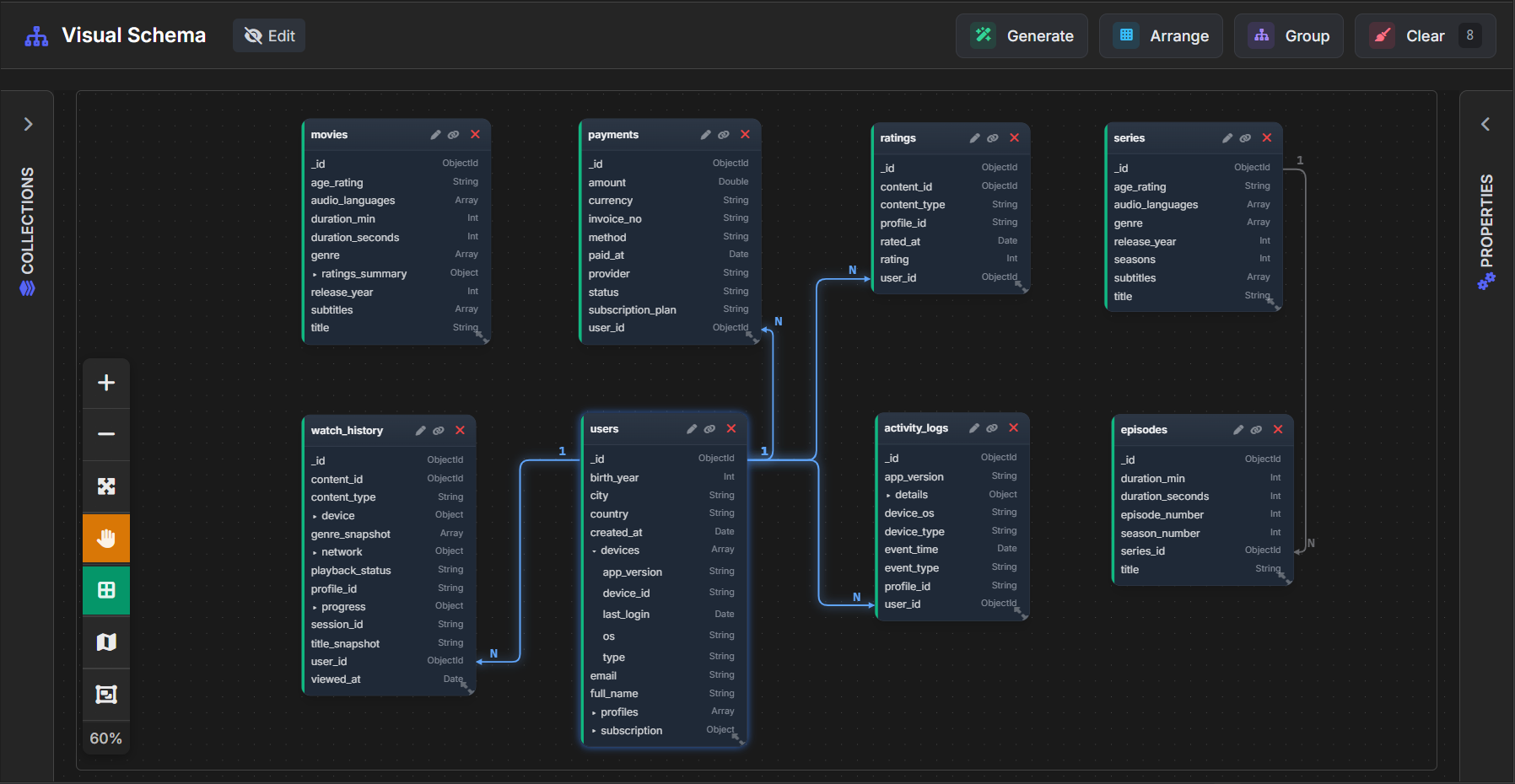
streaming_platform_db, showing embedded fields and referenced collections.For example, the users collection has fields like:
subscription
profiles
devices
These fields are stored inside each user document.
That means they are embedded.
But other collections, like payments, ratings, watch_history, and activity_logs, are connected to users with user_id.
That means they are referenced.
So the diagram shows the main idea very clearly:
Some data lives inside a document.
Some data lives in another collection and points back with an ID.
A Quick Example in Mongo Shell
To make this easier to see, here is a small example from the users collection.
In this document, subscription, profiles, and devices are stored inside the user document.
That means they are embedded.
db.users.insertOne({
  full_name: "Oliver Smith",
  email: "oliver.smith@streaming.test",
  country: "UK",
  city: "London",

  subscription: {
    plan: "standard",
    status: "active"
  },

  profiles: [
    {
      profile_name: "Oliver",
      type: "adult",
      preferences: {
        favorite_genres: ["Action", "Sci-Fi"],
        subtitles: ["en"]
      }
    },
    {
      profile_name: "Kids",
      type: "kids",
      kids_mode: true
    }
  ],

  devices: [
    {
      type: "laptop",
      os: "Windows 11"
    }
  ]
});
After creating this document in Mongo Shell, Visualeaf makes the embedded structure easier to see. The fields are inside the users document, not in separate collections.
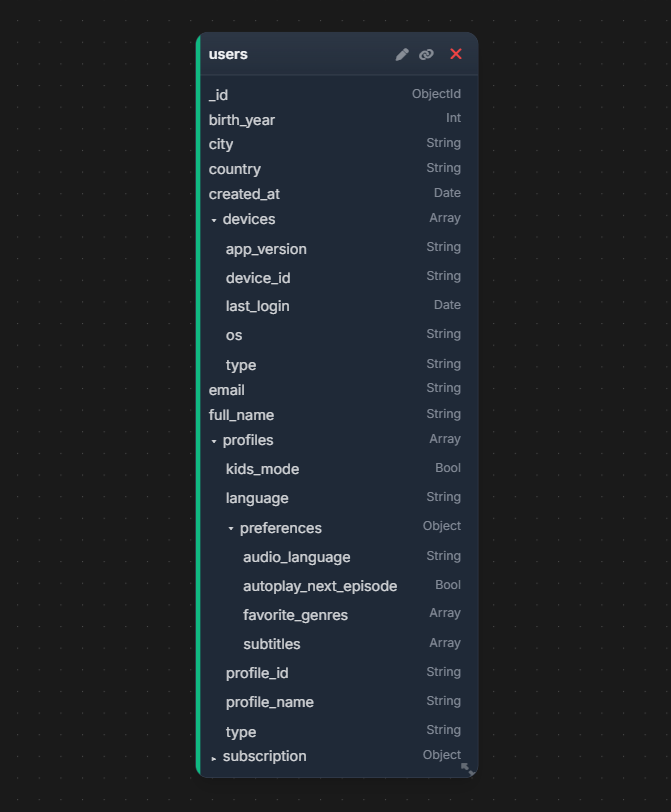
users collection. The subscription, profiles, preferences, and devices are stored inside the same user document.Now compare that with referenced data.
Payments are not stored inside the user document. They live in a separate collection and point back to the user with user_id.
db.payments.insertOne({
  user_id: ObjectId("USER_ID_HERE"),
  amount: 12.99,
  currency: "EUR",
  status: "paid",
  paid_at: new Date()
});
Here, user_id connects the payment to the user.
That is a reference.
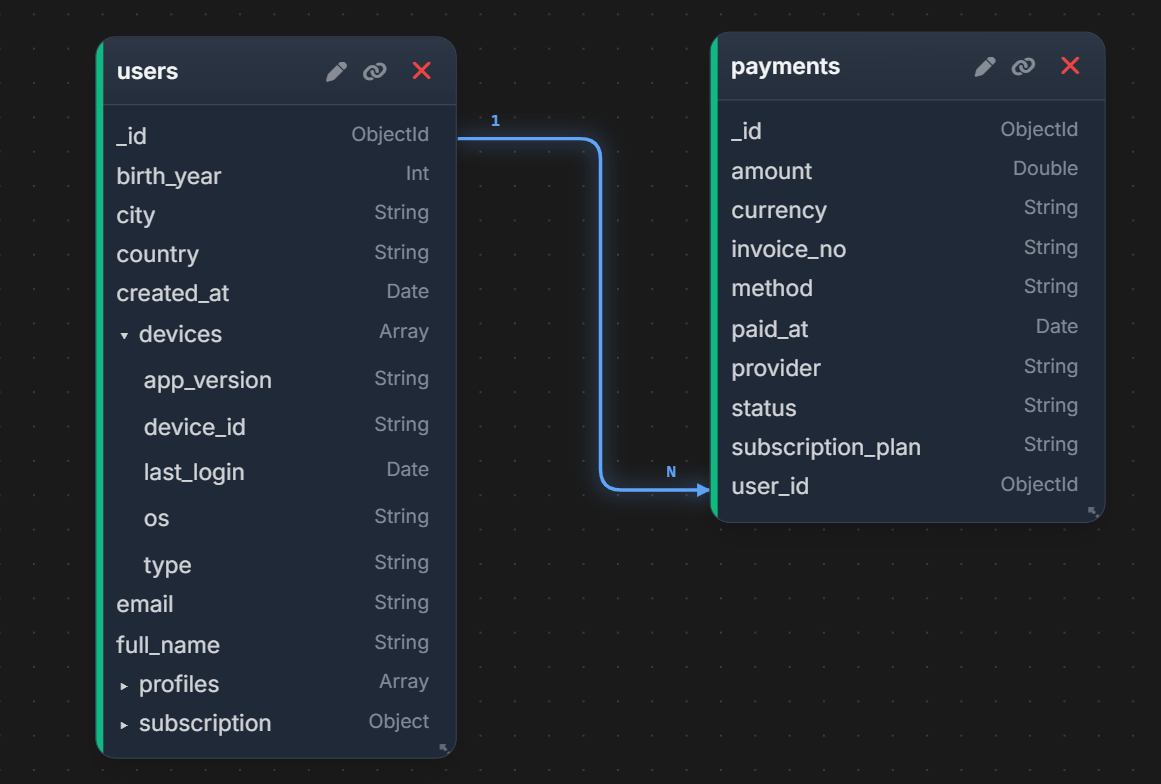
users and payments through user_id.One important thing to know: a MongoDB reference is not the same as a SQL foreign key.
In SQL, a foreign key can enforce the relationship between two tables.
In MongoDB, user_id is just a field that stores another document’s _id.
MongoDB does not automatically check that the user exists.
So the difference from the main diagram is simple:
users.devices       // embedded
users.profiles      // embedded
users.subscription  // embedded

payments.user_id    // referenced
ratings.user_id     // referenced
watch_history.user_id // referenced
activity_logs.user_id // referenced
Embed data when it belongs inside the document.
Reference data when it should stay in another collection.
Where embedding fits
Embedding is a good choice when your data is associated with one primary document.
Examples:
users
 └── subscription
 └── profiles
      └── preferences
 └── devices
If you open a user account, you will likely also want to see the subscription, profiles, and devices too.
So it makes sense to keep them together.
You do not need a separate collection for every small detail.
Simple rule: Embed data when it belongs to one parent and is usually read together.
Where Referencing Fits
Referencing is a good choice when the data can grow or needs to stay separate.
For example, payments should not be stored inside the user document.
A user can have many payments over time. One payment this month, another payment next month, and so on.
So it is cleaner to store payments in a separate collection.
payments
└── user_id
The user_id field points back to the user.
The same idea works for ratings, watch_history, and activity_logs.
ratings
 └── user_id
 └── content_id

watch_history
 └── user_id
 └── content_id

activity_logs
 └── user_id
These records are related to the user, but they do not need to live inside the user document.
They can grow fast, so they are better as separate collections.
Simple rule:
Reference data when it can grow, repeat, or connect more than one collection.
When to Embed vs When to Reference
Here is a simple way to decide.
| Situation | Better choice | Why |
|---|---|---|
| The data is small | Embed | It keeps related data in one place |
| The data belongs to one parent | Embed | The structure feels natural |
| You usually read the data together | Embed | You can get everything in one query |
| The data can grow a lot | Reference | It avoids huge documents |
| The data is shared by many records | Reference | It avoids copying the same data everywhere |
| You need to search or update it on its own | Reference | It is easier to query and index separately |
Conclusion
MongoDB schema design is about deciding where your data should live.
Some data makes more sense inside the same document.
Other data makes more sense in a separate collection, connected with an ID.
That is the difference between embedding and referencing.
A GUI tool like Visualeaf makes this easier to understand because you can see the database structure visually.
Instead of reading only raw JSON, you can see how collections connect, where data is nested, and how the schema is organized.
This makes it easier to read, explain, and improve your MongoDB database.

Try VisuaLeaf today!