
VisuaLeaf is a visual PostgreSQL GUI and SQL client built around everything that makes Postgres distinctive: expand JSONB and array columns in a tree, build SQL with CTEs and window functions, auto-draw ER diagrams from your foreign keys, read EXPLAIN as a plan, and chart the results.
PostgreSQL gives you JSONB, custom types, partitions, and an extension for everything — then hides all of it behind catalog queries and a plain-text execution plan. VisuaLeaf turns a Postgres database into a visual workspace: open JSONB as a tree, draw ER diagrams from real foreign keys, read EXPLAIN as a plan you can follow, and chart what a query returns.
A jsonb payload prints as a single flat blob, so nested keys and arrays have to be unfolded by hand before you can see what a row actually holds.
Nested loops, sequential scans, and cost estimates are buried in indented plan text, which makes it slow to find the one node where a query falls apart.
Relationships live in constraint definitions spread across the system catalogs, so the shape of the schema exists only in the head of whoever last worked on it.
Views, materialized views, functions, and extension-owned tables pile up along the search path, and the shell gives you no single place to see what exists.
Browse and edit JSONB as a tree, build queries visually or in SQL, map foreign keys into an ER diagram, read execution plans, and chart results — all in one workspace.
JSONB, custom types, CTEs, materialized views, EXPLAIN, and extensions like PostGIS and pgvector, explored, queried, and visualized instead of parsed from text.
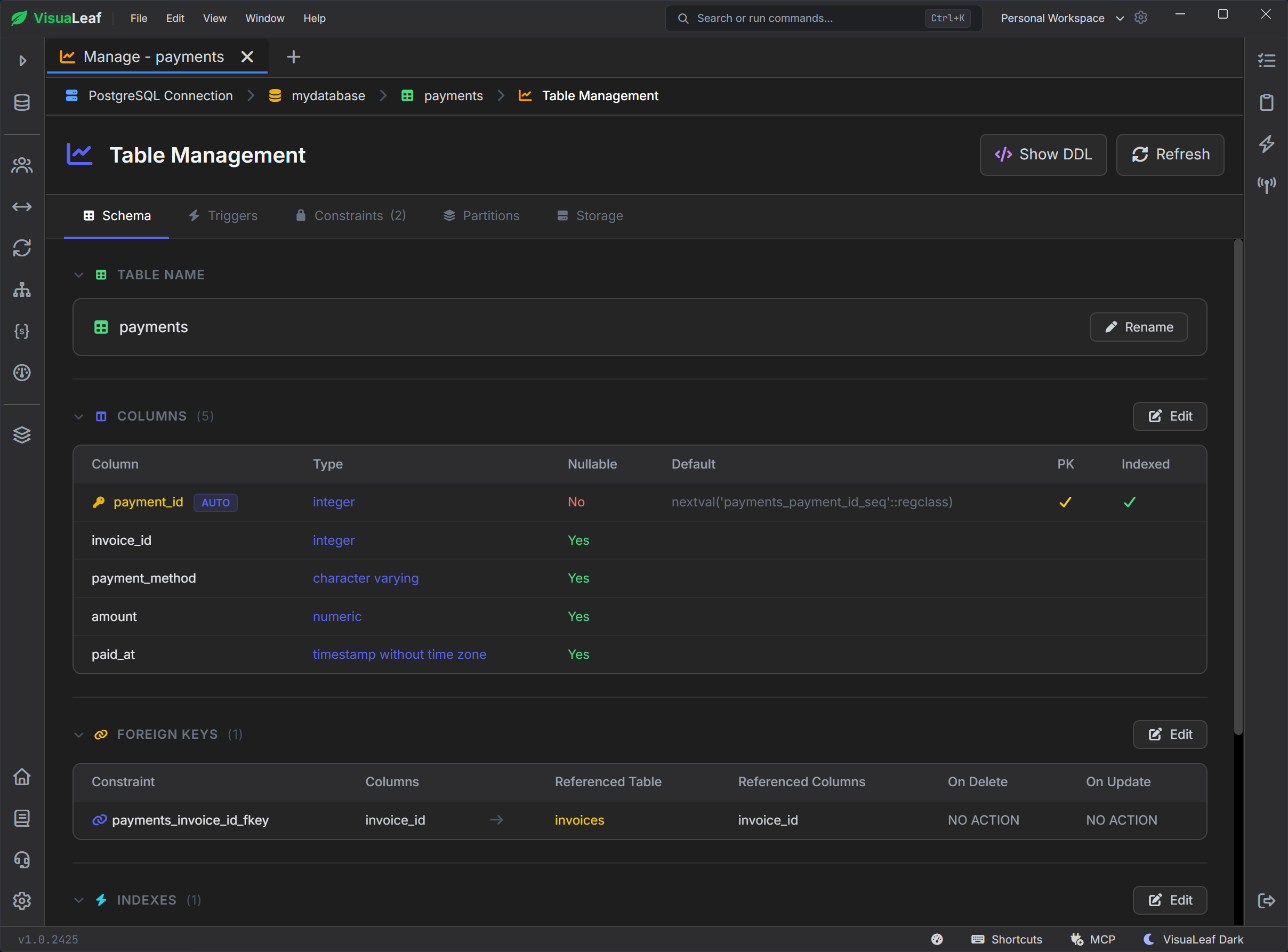
Manage tables visually instead of hand-writing DDL. Add, rename, and edit columns with their types, defaults, primary keys, and foreign keys, then work across tabbed panels for triggers, constraints, partitions, and storage. Hit Show DDL to read the full CREATE TABLE statement any time.
Expand jsonb, json, and array columns in a nested tree, filter with the ->, ->> and @> operators against GIN indexes, and edit nested values without hand-writing jsonb_set.

Auto-draw an interactive ER diagram from your real foreign keys and constraints, spanning multiple schemas plus views and materialized views, then drill into triggers, constraints, partitions, index DDL, and CREATE statements.

VisuaLeaf connects the steps Postgres users usually handle separately: connect to any instance, explore schemas and JSONB, build SQL, profile with EXPLAIN, and visualize.

Reach local, Docker, or managed Postgres, RDS, Aurora, Cloud SQL, Supabase, Neon, over SSL or an SSH tunnel.
Browse schemas and the search_path, tables and views, and expand JSONB and array columns in a tree.

Assemble JOINs, CTEs, and window functions visually, or drop into the SQL editor with autocomplete.
Query, update and index JSONB columns, then read the results as a tree instead of one flat blob.
JSONB is where many Postgres schemas keep their flexible data, and it is also where a plain SQL client gets hardest to read. VisuaLeaf shows JSONB results as a tree, so you can check what a query really returned before you index or update it.
Filter with the ->, ->> and @> operators, then expand nested objects and arrays in the result tree, with the type of every key shown next to its value. Edit nested values without hand-writing jsonb_set.
Result viewer docsA hands-on guide to querying nested JSONB values, matching part of a document with @>, updating one nested value with jsonb_set, and adding a GIN index for containment searches.
Read the JSONB guideHow JSONB is stored, updated, and indexed compared with a document database, and when keeping JSON inside PostgreSQL is the right call for your workload.
Compare JSONB and BSONWhether you model data in JSONB, tune a slow plan, review roles and Row-Level Security, or learn SQL, VisuaLeaf gives you a clearer way to work with Postgres.
Model data with JSONB, arrays, ENUMs, and custom types, and debug the SQL your app runs against real rows.
Compare schemas, review roles, privileges, and Row-Level Security, and profile EXPLAIN plans across environments.
Write CTEs and window functions, query JSONB, and chart the results without a separate BI pipeline.
Learn Postgres visually, see foreign keys as ER diagrams and turn the query builder into readable SQL.
VisuaLeaf started as a MongoDB workspace and grew into a multi-database visual environment. One app, one workflow, across the databases your team actually uses.
And VisuaLeaf does not leave you staring at a wall of SQL and grids. It visualizes everything — PostgreSQL schemas become interactive diagrams, queries become visual builders, and results become charts and dashboards.
VisuaLeaf is made by an independent software studio that ships often and listens to the developers who use it every day.
Download VisuaLeaf Community Edition and explore JSONB, build SQL with CTEs and window functions, draw ER diagrams from your foreign keys, and profile EXPLAIN plans in one visual workspace.
Download Free Community Edition